
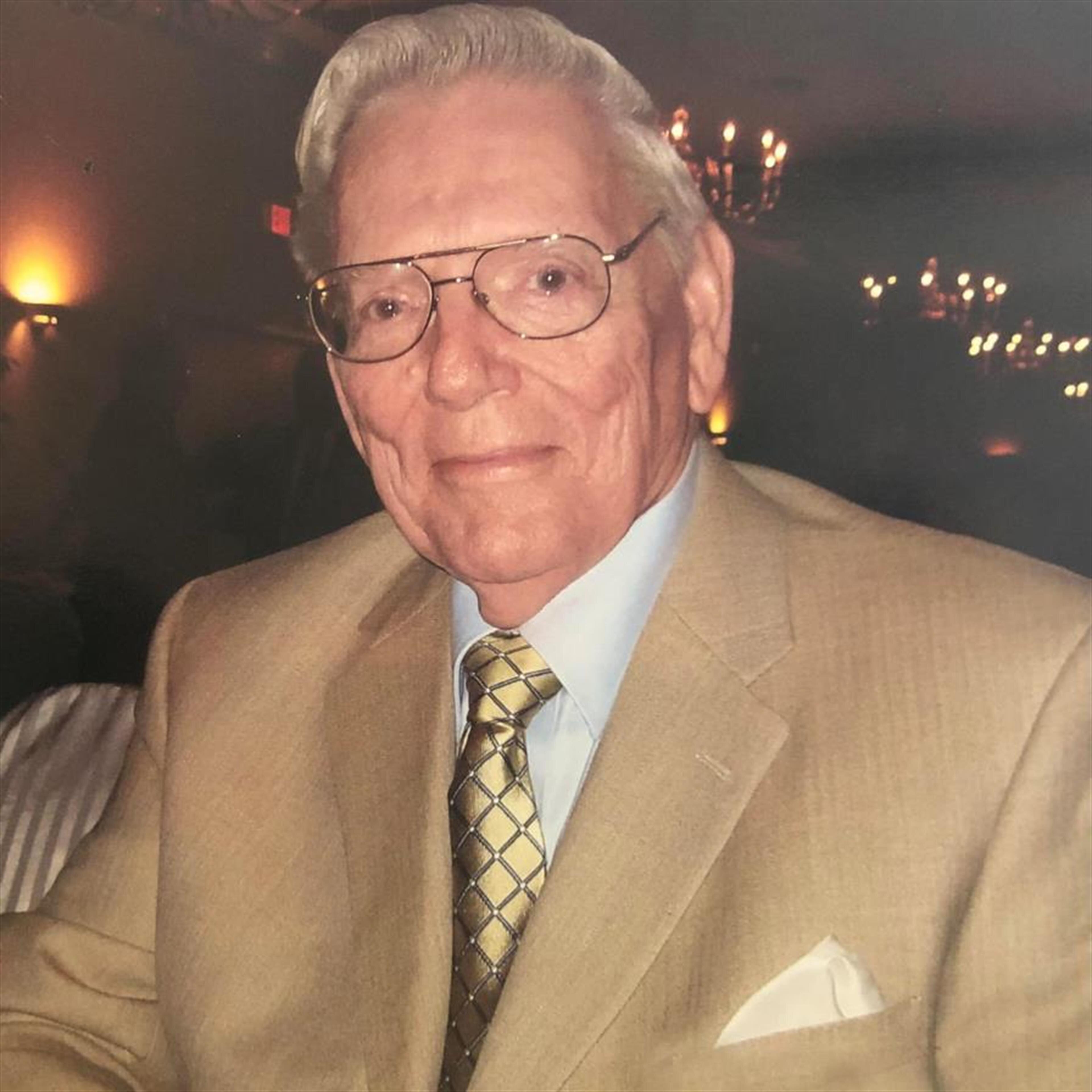
Charles Edward Eckert's Obituary
Charles Edward Eckert was born to Edward and Jewel Eckert in Wichita Falls, Texas on October 5, 1931. Charles was baptized in the First Presbyterian Church of Wichita Falls on March 27, 1932. While he never shared much about his youth, we do know he loved the outdoors, a passion he retained until his death. As a boy, he was a Cub Scout and later a Boy Scout, earning the rank of Life Scout, a member of the Order of the Arrow and an Explorer Scout while in high school. He hunted and fished with his Father Ed and his uncle Jake, and Ed Ogalsby, his Explorer Scout leader among others and shot and killed a trophy buck at about age 16. The trophy still hangs in one of his son’s homes. Charles worked in his father’s meat market (The Palace Market). It was a true meat market of the times where they ran their own beef feeder yards, slaughtered their own cattle, hung the beef in coolers to age three weeks or so (a process known as dry aging which is rarely done these days), and carved steaks, ground meat and did all the things old time meat markets did before large grocery stores essentially put meat markets like this out of business. The Palace Market closed some time in 1957 as we recall.
Charles attended and graduated from Wichita Falls Senior High School in 1949, then went off to Texas A&M (which was an all men’s military academy at the time) for his first two years of college. In 1952, he transferred to Arlington State College, and then to North Texas State College in Denton (now called the University of North Texas) where he graduated in 1953. In 1968-69, he earned a Master’s Degree in International Affairs from George Washington University in Washington, D. C. Charles was the first in his family to earn a college degree, let alone a master's degree.
Being a third generation Texan, the only State in the Union to have been a separate republic before becoming a state, and having lived through a World War and the Korean War, Charles loved his country in a very deep way. He believed his country was good and did good for others. He believed he should repay some of what his country had given him as an American, and the best way he could demonstrate that was to become a member of the uniformed services. The U. S. Air Force, having been formed as a separate branch of service in 1947, was new relative to the Army and Navy, and he believed the perfect place for him. Unfortunately, however, he had really bad eyesight and consequently was not pilot qualified but didn’t want to be a navigator (too boring). Although commissioned as an officer on March 15, 1954, (March 15 was also his mother’s birthday, too) he had to receive a waiver from Congress to remain in the Air Force. The waiver was granted 30 days later and Charles was sent to Scott Air Force Base in Illinois to receive training as a Communications Wire Officer. Afterward, he was stationed to Hill Air Force Base in Utah where he received training as a communications officer aboard B-26’s and later the new B-57 Canberra which was a tactical bomber and reconnaissance aircraft. The operative word here is “reconnaissance.” Apparently that is what Communications Wire Officers did…fly secret reconnaissance missions. Interestingly, the B-57 was later reincarnated as the U-2 Reconnaissance aircraft of Francis Gary Powers fame. Having been stationed at a “listening post” in the newly activated Air Force Special Security Office at Wheelus Air Force Base in Tripoli, Libya, Charles was on duty the night the Russians knocked Powers out of the sky with a lucky shot from a MiG firing an air-to-air missile at its altitude ceiling and catching the wing of the U-2 flying at about 100,000 feet. Charles and his team were tracking Powers when he was hit, telling him to fly evasively instead of straight and level because at some point the Russian MiGs were going to get lucky and hit a U-2. Before the end of the night, they were proven right…in Charles’ inimitable way he said Powers’ arrogance and refusal to fly evasive patterns was the only reason he got shot down, and that event compromised national security unnecessarily.
Before his assignment in Tripoli, while still stationed as Hill AFB, Charles met Gladys (Glade) Thora Siouris, and on April 30, 1955 they were married at St. Mark’s Episcopal Cathedral in Salt Lake City. Glade used to tell the story of her seeing an astrologer in 1953 where she was told she would marry a man in uniform. All she thought of was policemen and firemen and she wasn’t too keen on that idea. Little did she realize that “a man in uniform” also meant a military man.
Charles was promoted rapidly and became a Captain in 1960 while attached to the National Security Agency at Fort George G. Meade in Laurel, Maryland. In 1962 he was stationed to Itazuke AFB in Japan at another “listening post” monitoring and tracking secret Air Force flights in and around southern Japan and Southeast Asia. This particular “listing post” was literally a cave dug out of the top of a rock mountain in the Japanese countryside. A big part of his job was trying to keep the Japanese from shooting at the super-secret hypersonic SR-71 flights originating from Kadena AFB in the Philippines and flying over southern Japan enroute to China and North Korea for intelligence gathering missions. In 1965, when the U. S. was “not involved” in the emerging conflict in Viet Nam, Charles spent time in the county setting up a ground sensor operation to track troop and equipment movements. This tour earned him the Armed Forces Expeditionary Medal. Later in 1969 and 1970, he found himself in the middle of the Viet Nam conflict as the Wing Combat Information Control Officer aboard unarmed EC-121 Constellation reconnaissance aircraft, using the very sensors he set up to track the VC four years before. While with the 553rd Recon Squadron (The Batcats) stationed out of Korat, Thailand, he was involved in over 50 air missions flying 528 hours (note that is over 10 hours per mission) in the EC-121R, AC-130 gunships and low flying helicopter missions to conduct battlefield damage assessments after the fighters, bombers and ground artillery laid waste to their targets. His tour in Viet Nam was secret. He literally flew into and out of Thailand on civilian airlines in civilian clothes and on verbal orders only. He did not receive his written orders until he returned to the U. S. in 1970. While in Viet Nam, he earned a Bronze Star and two Air Medals.
Charles also served first as a student and then as an instructor at the Air War College and the Air Command and Staff College at Maxwell AFB in Alabama. He was a Boy Scout Scoutmaster at Maxwell and again after Viet Nam on a second assignment to Japan at Fuchu Air Station. Upon retiring from the Air Force as a Major in 1974 after nearly 21 years’ service, he became a high school teacher at Winston Churchill High School in Rockville, Maryland. In 1979, he returned with his family to north Texas to become a teacher at Burkner High School in Richardson. He taught for 14 more years and retired for the second time in 1993 at age 61.
While with the Air Force, in lieu of fishing and hunting, not easy things to do as a U. S. serviceman in foreign lands, he became active in military sponsored gun clubs. He shot competitively and was ranked as in Expert Marksman with the .22, .38 and .45 caliber pistols. He was also ranked as an Expert with the rifle, and missed out on becoming a Master Marksman by small margins on several occasions. Charles loved woodworking and working with his hands generally. He was very artistic, a trait he never really fully developed, which is a loss to us all. What artistic endeavors he did undertake were detailed and finely executed. He also dabbled in real estate with Glade over the years purchasing and leasing several houses and residential condos in the growing and ever appreciating Dallas market, all of which contributed to his retirement income and accumulated net worth.
Charles’ wife of 64 years, Glade, died on June 4, 2019 at 90. He is survived by his older sister, Betty Jean Rowe, his brother-in-law, Theodore Siouris and wife Aida, his sister-in-law, Michele Siouris, his three sons and their families, Charles Jr. and Christina Eckert and their children, Alex, Paris (and fiancé Zachary), and Cloë, Mike and Serena Eckert and their children Maxx (and fiancée Erin) and Eric, and Ted and Debbie Eckert, his niece Lexi Hall and nephew Harvey Rowe.
May the Lord Jesus Christ keep the soul of his child, Charles Edward - American Airman, Husband, Father, Teacher - and may he rest in peace.
What’s your fondest memory of Charles?
What’s a lesson you learned from Charles?
Share a story where Charles' kindness touched your heart.
Describe a day with Charles you’ll never forget.
How did Charles make you smile?
